Bereishit….Beginnings

Beginnings (2): Genesis 1

By Julia BlumJanuary 8, 20202 comments

As we advance with the days of this year, we are also advancing with the days of Bereishit  and continuing to watch in awe God’s work of creation. Today, first of all let us consider different verbs that describe His work during these days.

VaYomer – and He said

And God said: “Let there be light.” And there was light.

Nine times, during six days of creation, we read: “And God said” –   וַיֹּאמֶר אֱלֹהִים.  For me personally, these verses are the most wonderful evidence of that glorious beginning—that glorious order of things, when everything was so different from now.  In our fallen world we live by faith, by the evidence of the things not seen, and seldom in our lives do we experience this amazing turn of events: “God said” – and that is how it was, without any pause or delay in between. There are many things that we know God said – and we also know that these things will eventually come to be; but this glorious immediate embodiment of God’s word, this immediate visible fulfillment of what He said, is called and perceived as a miracle in our fallen world. Mostly, we see these things by faith, not by sight. But it was not a miracle then—it was the normal course of events in a world not distorted by evil.

Moreover, from this verb  VaYomer – and He said – we see absolutely clearly that not only is God the only one who has life-giving power, but the source of this life-giving power is His word—that He gives life by the authority of His Word only. According to the New Testament, Jesus is the Word of God, and therefore, we are not surprised to find almost the same description of the beginning of the creation in the New Testament—in the Gospel of John. The language of John clearly and purposely echoes the language of Genesis 1:1: both in the Genesis account and in John’s Gospel, it is the Word of God that brings forth life. This is one of the foundations of New Testament faith: “By faith we understand that the worlds were framed by the word of God.[1]

For instance, we see a huge difference between how people restore life in the Tanach, and how Jesus restored life. Read, for example, the description of how the prophet Elisha raises a child from the dead. He prays, he stretches himself out on the child’s body to warm him, he prays again—then the Lord answers Elisha and the child is restored to life.[2] Jesus, on the other hand, restores life in exactly the same way God creates it, by the authority of His Word only: In every gospel story where Jesus raises the dead, He simply speaks: Talitha, kumi!” “Lazarus, come forth!” “Young man I say to you, arise!” This means that the gospel writers clearly saw His spoken word having the same life-giving, creative power as in Genesis: for the New Testament writers, the same Word creates life in Genesis, and restores life in the gospels.

VeYavdel  –and He separated

And God saw the light, that it was good; and God divided the light from the darkness.

We have to understand that during the first days of creation, God’s main action is lehavdil, “to separate”. We find this verb “separate” used several times in these verses. It occurs in Gen. 1:2, 6,7,14,18. On the first three days of creation, God separates 1) light from darkness, 2) the waters above from the waters below, 3) dry ground from the waters. The very first fruits of the land come only on the third day, after the work of havdala, separation, is complete. Like everything else in the Tanach, it definitely has profound spiritual meaning: God always wants to separate darkness from light, and in order to do the work of God, we must choose light and separate ourselves from darkness. One can bring forth fruits in one’s life only if the work of separation comes first—only if one separates oneself  from the darkness.

VaYikra –and He called (gave names)

As we have already seen, God’s word is the main part of the whole creative process – and this verb, VaYikra, also reflects this.

God called the light Day, and the darkness He called Night[3].

And God called the firmament Heaven[4].

And God called the dry land Earth, and the gathering together of the waters He called Seas[5].

God gives names to elements of His creation, and this becomes an essential part of their existence. In this light, it is extremely significant that the very first thing we see Adam doing is giving names – VaYikra – to all the animals (Gen. 2:19, 20). We will address this subject at length in my next posts, when we will talk about Adam.

The Creation of Man

The First, Second and Third days of creation prepare us for days Four through Six. On these days, He creates by 4) by providing lights in the firmament; 5) filling the sky and sea with winged life and sea creatures; and 6) finally creating animals and man to fill the dry land. Undoubtedly, there is a deep structure to this chapter: a careful reader gets a clear sense that there is a plan, and we are going somewhere with this. The first chapter of the Torah presents the ascent of the cosmic drama culminating in the creation of man. As we read the description of each day of creation, we feel the story building up, then in Genesis 1:26-27 we come to the crescendo: “So God created man in His own image…“[6] Everything that has been created so far, has to be seen now in the light of this verse—according to Jewish understanding, it is only when a man was created that the whole of creation became meaningful.

That is why, by the way, the day Jewish people celebrate as Rosh Hashanah (Jewish New Year) – the first of Tishrei – is not perceived as the anniversary of Creation, it is the anniversary of the sixth day of Creation, when Adam and Eve were created. The anniversary of the first day of Creation would be five days before, on the twenty-fifth day of Elul. Why? – Because once again, in rabbinic tradition it is the birth of humanity that made the whole creation meaningful by adding to the universe the possibility for God to be proclaimed King. Next time, will speak more about this fascinating Sixth Day, and discuss in detail the creation of a man, and his relationship with his Creator.

[1] Heb. 11:3

[2] see 2 Kings 4:32-36

[3] Gen.1:5

[4] Gen.1:8

[5] Gen.1:10

[6] Gen.1:27

This really piqued my interest

Native American People have always been a One God People.

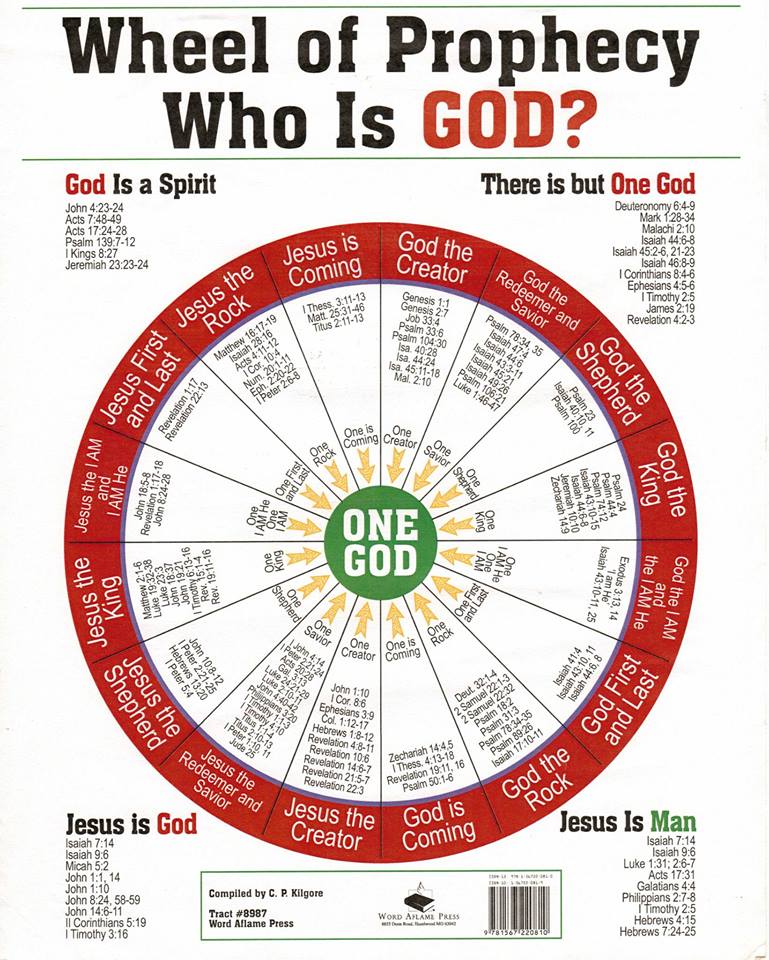
This diagram a friend gave me piqued my interest as we Native People have always been a One God People, just like the Ancient Hebrews. We didn’t worship the Sun, nor the Stars, or any other heavenly body, our pipes, our eagle feathers, or any other thing within the belief system(s) of our people. We treasured such things realizing there was a Being of Superior and Supreme Power that created those things for us. We knew that Being was Omniscient, Omnipresent, and Omnipotent as we saw His Hand in everything in our Natural World.

We saw the wonderful creatures he created for us, the other things of nature he gave us, the fresh water, the air, Oxygen, the Green Foliage, The Rock upon which we live, other rocks in the Universe meant as special helps to aid us and guide us when needed. Our Belief System could be summed up as follows; we believed in the Two Legged, the Four Legged, the Creeping Crawling Things, the Winged beings, the Fire, the Rock, the Water and the Green. We also knew there existed a Past, Present and Future about all those things. Upon this hung Life as we knew it and understood it. We were not aware of John, chapter 1:1-4 and what it had to say from the Hebrew writings, but we knew He was One God, not many, and we accepted the simplicity of those beliefs.

Iw enajmoyan ngom

Nin se Neaseno.

Very interesting article

Whatever Is Not from Faith Is Sin


  • Resource by

John Piper

The Old Testament (Psalm 32:1, 2) and the New Testament (Romans 4:7, 8) agree: “Blessed (or fortunate) is he whose transgression is forgiven, whose sin is covered. Blessed is the man to whom the Lord imputes no iniquity.” Therefore, both, by implication, agree that the person whose transgression God does not forgive, and whose sin is not covered but open in all its offensiveness before the face of a holy God, and to whom the Lord does impute iniquity—this person is not blessed but is very, very unfortunate. Even if the unrepentant and unforgiven sinner prospers in this age, we may be sure on the authority of God’s Word, he will not escape judgment. For it says in Romans 2:4, 5, “Do you presume upon the riches of his kindness and forbearance and patience? Do you not know that God’s kindness is meant to lead you to repentance? But by your hard and impenitent heart you are storing up wrath for yourself on the day of wrath when God’s righteous judgment will be revealed.”

The Deceitfulness of Sin

If this is true, and if our worst imaginations of what the outpouring of the wrath of an infinite creator might be like are but a shadow of its real horror, then there is nothing more important for any person in this building or in the world than to recognize his sinfulness and find a way of forgiveness before God. But one of the characteristics of sin is that it is deceptive. Hebrews 3:12, 13 says,

Take care, brethren, lest there be in any of you an evil heart of unbelief leading you to fall away from the living God. But exhort one another every day as long as it is called ‘today’ that none of you may be hardened by the deceitfulness of sin.

At the heart of all sin is a lie. The lie says to all of us in our sin, “The act you are now doing, the desire or attitude you are now feeling is not very bad because there are much worse things, not very bad because everyone else experiences the same things, not very bad because you can’t help it, not very bad because there is no God, or, if that won’t work, God knows you are but frail and weak and he will tolerate and pity your sin.” There are a thousand distortions of the truth which sin brings with it into the human heart, so that Jeremiah cries out, “The heart is deceitful above all things and desperately corrupt; who can understand it?” (17:9).

Sometimes I despair at the subtlety of the sin in my life; how it manages to distort reality and blind to truth and spark foolish and evil inclinations. And when I look at the world, the small world of my neighborhood with its thievery and drunkenness and sexual promiscuity, or the larger world of horrible torture stories from Garcia Meza’s Bolivia or the Gary Hastings slaying their wives and then trying to blow their own brains out with a shotgun but instead leaving themselves alive with no face—as it were, a symbol of the horror of sin in the world—when I look at the subtlety of sin in my own life and its iron clad grip of deception on the world at large, I sometimes ask what hope there is of opening anybody’s eyes to the ugliness of sin and to the awful peril of condemnation if we fail to repent and be forgiven.

But then I remember the promise concerning the power of God’s Word in Hebrews 4:12, 13.

For the word of God is living and active, sharper than any two-edged sword, piercing to the division of soul and spirit, of joints and marrow, and discerning the intentions of the heart. And before him no creature is hidden, but all are open and laid bare to the eyes of him with whom we have to do.

Nothing exposes our sinfulness like the Word of God. It blows away the thick fog of deception and lets us see sin for what it really is. Not that we might wallow in it, but that we might flee from it.

Therefore, my goal today is to let the Word show us what sin is, and why it is sin. There is seldom a cure to any disease without a diagnosis. That is what I want to offer today: God’s diagnosis of our human disease called sin. If we don’t know what it is, it will have a great deal more power over us. If we do know, then we will be able to avail ourselves of the Best Physician, who is a sin specialist, and of his medicines which are needed to keep the disease in check.

What Is Sin?

The most penetrating and devastating definition of sin that I am aware of in Scripture is the last part of Romans 14:23: “Whatever is not from faith is sin.” The reason it is penetrating is that it goes to the root of all sinful actions and attitudes, namely, the failure to trust God. And the reason it is devastating is that it sweeps away all our lists of dos and don’ts and makes anything, from preaching to house-painting, a candidate for sin. In the original language, this is stressed even more than in our versions: it says, “Everything which is not from faith is sin.” Anything, absolutely any act or attitude which is owing to a lack of trust in God is sin, no matter how moral it may appear to men. God looks on the heart.

In Romans 14, Paul addresses a situation in which some believers thought it was wrong to eat meat (they were vegetarians) while others thought that all foods are pure (they ate everything). Some were teetotalers; others drank wine. Paul agreed with those who saw all things as pure in themselves but something was more important to Paul than making all the Roman believers into meat-eaters or wine-drinkers. He wanted both groups to walk in love and not do anything to injure the other’s faith. Notice verses 2 and 3:

One believes he may eat anything, while the weak man eats only vegetables; let not him who eats despise him who abstains, and let not him who abstains pass judgment on him who eats; for God has welcomed him.

Then verses 14 and 15:

I know and am persuaded in the Lord Jesus that nothing is unclean in itself, but it is unclean for anyone who thinks it unclean. If your brother is being injured by what you eat, you are no longer walking in love.

Then verse 21:

It is right not to eat meat or drink wine or do anything that makes your brother stumble.

Therefore what Paul is doing in this chapter is redefining sin for these people. Sin cannot properly be defined in terms of mere acts like eating and drinking, it must be defined by its root. An act of eating meat may or may not be sinful according to whether it springs from love (verse 15). But there is yet a deeper root than love or lack of love and that comes out in verses 22, 23: “Do you have faith? Keep it to yourself before God.” I think Paul means here that if your faith frees you from feeling guilty about eating meat, for example, don’t think you have to flaunt your freedom at the expense of injuring others.

Then he goes on, “Blessed is the person who does not judge himself for what he approves.” In other words, it is a joy to have a clear conscience, not to feel guilty for what we choose to do or not do. Then he concludes, “The person who doubts is condemned if he eats, because he does not act from faith; everything which is not from faith is sin.”

What Paul is saying here is that if you are not sure whether eating meat is wrong and you think it might be, but you go ahead and eat it anyway instead of denying yourself to avoid what you think might be sin, then you are condemned, that is, guilty of sin. The reason he gives is that such eating is not from faith and whatever is not from faith is sin. Now the assumption here is that to go ahead and eat meat when you think it may be wrong is an eating which does not come from faith. Why? Why can’t such eating be from faith?

The Nature of Saving Faith

If we can answer this question we can know more precisely what Paul means by faith in verse 23 and in turn what the nature of sin is. Why is it that we are not acting from faith when we go ahead and do something we think may be wrong? The answer jumps out at us, I think, when we ask another question, namely, “Why do we go ahead and do something we think may be wrong or harmful to others?” Isn’t the answer that we feel that if we don’t do it we won’t be as happy? We are willing to risk hurting someone or doing what we feel may be wrong, because that course of action seems to hold out the most happiness to us. We do what we do because we think doing it will make life more pleasant or at least bearable. But if that is so, it is easy to see how our behavior is not from faith. Faith would see the possible wrong or injury which our action may cause and would feel no need to risk it in order to make our future happier, because faith trusts God to construct a future for us which is vastly to be preferred to the one we could make for ourselves. Therefore, it is obvious that when we try to make our own future happy at the risk of wrong or harm, we are certainly not acting from faith, for faith rests in God to shape the best future for us.

Here we get a glimpse into what Paul means by saving faith and why it is that genuine faith always changes lives. What comes out of verse 23 is that faith is confidence in God to work in the affairs of our lives so that only what is best for us happens to us. What a power would be unleashed in your life and mind if we really believed that the almighty God, whose counsel cannot be frustrated, is this very minute, as I preach, busily at work making sure that what happens to us this afternoon and tomorrow at home and at work is only what is best for us!

There is a grave error in the church today which says that saving faith focuses mainly on what God will not do to us, namely, hold our sins against us. This is a grave error because in the Old and New Testaments an essential (not optional, but an essential) element of faith focuses on what God will do for us now and in the age to come. Saving faith is confident not only that God has forgiven our sins through the death of Christ, but also that God is now at work in the everyday affairs of our lives to do us good. According to Romans 8:32: “He who did not spare his own son, but gave him up for us all, will he not also give us all things with him?” Yes, he will, and saving faith is confident of this. Of course, “all things” means all things that are best for us, including all sorts of tribulation. Which is why Paul said in Romans 5:3–4, “Let us rejoice in our sufferings, knowing that suffering produces endurance, and endurance approvedness, and being approved produces hope.” Saving faith is primarily future oriented. And I don’t mean merely heaven-oriented. I mean it is oriented to tomorrow morning and is confident that God is going to work that worrisome situation out.

Abraham was justified by his faith. He stood clean before God. But what was his faith? Romans 4:20 says, “He did not doubt the promise of God in unbelief but was strengthened in faith, giving glory to God, being fully convinced that God was able to do what he promised.” Saving faith means resting in the promises of God. What promises? All the promises, including, God works everything together for good for those who love him (Romans 8:28); he will follow you with goodness and mercy all your days (Psalm 23:6); he will not leave you or forsake you (Hebrews 13:5). Saving faith is confident in the promises and power of God. Therefore, it is not anxious about tomorrow but has joy and peace, taking God at his word. So Paul says in Romans 15:13, “May the God of hope fill you with all joy and peace in believing that by the power of the Holy Spirit you may abound in hope.” Trusting the God of hope gives joy and peace. And the reason it does is because our confident hope is that God is at work right now and tomorrow in the everyday affairs of our lives so that only what is best for us happens to us.

This, I believe, is what lies behind Romans 14:23. Sin is anything, any act or any emotion or attitude, that does not sprout from the soil of such confidence in the God of hope. “Whatever is not from faith is sin.”

Unbelief: The Root of Sin

There are three implications of this definition of sin which I want to try to drive home. First, the all-pervasive fault in every sin is its character of unbelief. Let there be no confusion here. By unbelief I do not mean a refusal to accept the truths of the Bible. We are not saved by giving mental assent to the promises of God. We are saved by whether we hope with our hearts in those promises. The failure of the heart to be confident in the promises of God and to rejoice and find pleasure in his provision for the future is the root and essence of all sin. Unbelief is what mainly displeases God in every sinful act. As Hebrews 11:6 says, “Without faith it is impossible to please God.”

And rightly so, because unbelief is a terrible insult. If a friend offers to do you a favor and promises by his honor to see it through, but you decline the offer and say, “No, friend, I’ve decided I just can’t trust you any more,”—if that is your response to his promise, the friendship is over. You have insulted his integrity and robbed him of his honor. And there is just cause for animosity against you to rise in his heart. Moreover, the offensiveness of your insult would increase in direct proportion to the dignity of your friend. In other words, the greater his wisdom and honor and dependability, the uglier and more inexcusable would be the insult of your failure to take him at his word.

This helps me feel a little bit of how horrid sin is, because God is infinitely wise and infinitely honorable and infinitely dependable, and has paid an infinite price to put all this at our disposal for our good. What an intolerable offense it is then for a puny little human, absolutely dependent on this God’s grace for every breath he takes, to say with his behavior to God, “I don’t really think you can be counted on to make a better future for me than I can make in following my own way.” If such unbelief persists there will be judgment (which is what I want to talk about next week). A failure to delight and trust in the promises of God is the greatest insult you can pay to God and therefore the primary offense in all sin.

Sin Is Not a List

The second implication of Romans 14:23 is that we cannot view sin any more merely as breaking the ten commandments or transgressing a list of dos and don’ts. “Everything that is not from faith is sin.” Coming to church may be sin, staying home may be sin. Eating steak may be sin and not eating steak may be sin. Sexual intercourse with your own wife may be sin and the refusal of sexual relations may be sin. One of Satan’s most successful lies is that sin can be limited to a manageable list of dos and don’ts. The reason this is so satanic is that it causes thousands of churchgoers to think that things are OK between them and God because they avoid one list of don’ts and practice another (much shorter) list of dos; but in fact may be sinning all day long, incurring the wrath of God, because their attitudes and actions do not come from faith in the promises of God.

Please don’t think that this cannot happen to people in the church, in our church. Paul wrote to the Thessalonians, “When I could bear it no longer, I sent that I might know your faith, for fear that somehow the tempter had tempted you and that our labor would be in vain.” Among churchgoers, Satan is primarily in the business of replacing vital faith with mere morality. He loves to take a life flowing from happy confidence in God and turn it into a perfunctory religious regimen. Don’t let him do it! For “whatever is not from faith is sin,” including religion.

The real battle of life is not fought at a low-lying delta where the river of our inclinations flows into action, but at the high, less accessible spring of faith. If the stream doesn’t start in the spring of faith, it does not matter where it flows, it will issue in sin. Therefore, as Proverbs says, “Keep your heart with all diligence, for from it flow the springs of life” (4:23).

All Things Are Sin for the Unbeliever

The third and final implication of Romans 14:23 is a warning to those who have not sought Christ for forgiveness or placed their hope in him. If there are any among you like this, do not say to yourself, “‘My sins are slight, or my sins are few.” For according to Romans 14:23, everything you do is sin. If you are not trusting Christ for forgiveness and are not resting in his daily work on your behalf, then none of your actions comes from faith, but every one of them (even the most noble) is sinful and an insult to the infinitely trustworthy God. And I hope, if you have not received Christ with all his forgiveness and all his hope, that this week you will not be able to shake loose the thought that everything you do is sinful in God’s eyes, for whatever does not come from faith is sin.

I have a better suggestion for you who have not entrusted yourself to Christ or received him as your Savior and the Lord of your life. Do it right now, and you can enter the week with no condemnation.

I am going to pray a prayer which I hope every person in this room will pray with me. If you are Christ’s already, the prayer will confirm it. If you are not and now want to be, this can be the moment of your conversion. Pray with me silently if you mean it.

Almighty God, I cannot escape from your pursuit. You have found me and inclined my heart to believe in you.

I confess my great sin and I know I deserve to be condemned for insulting you by my lack of faith.

But I believe now in Jesus, that as your Son he died to bear my sin and punishment, so I could live forever and walk in newness of life. I take him as my only hope and acknowledge him as my Lord.

Thank you, Father, for your forgiveness and your promise to be with me. Guard me now from the evil one.

Amen.
A very apt posting for today

Who Is God?

Who Is God – Who Does He Claim to Be?
Who is God? He’s been described as everything from an impersonal life-force to a benevolent, personal, almighty Creator. He has been called by many names, including: “Zeus,” “Jupiter,” “Brahma,” “Allah,” “Ra,” “Odin,” “Ashur,” “Izanagi,” “Viracocha,” “Ahura Mazda,” and “the Great Spirit” to name just a few. He’s seen by some as “Mother Nature” and by others as “Father God.” But who is He really? Who does He claim to be?

Who Is God – Father God or Mother Nature?
Who is God? What has He revealed about Himself? To begin with, whenever He refers to Himself in parental terms, He always addresses Himself as “Father,” never “Mother.” He calls Himself “a Father to Israel,”1 and in one instance, when His “children” were particularly disrespectful to Him, He said to them, “A son honors his father, and a servant his master. If then I am the Father, where is My honor? And if I am a Master, where is My reverence?” 2

His prophets acknowledged Him as Father by saying, “You are our Father, we are the clay, and You our potter; And all of us are the work of Your hand,”3 and “do we not all have one Father? Has not one God created us?”4 Never once does God refer to Himself as “Mother” and never once is He called such by the prophets to whom He spoke. Calling God “Mother Nature” is comparable to calling your earthly father “Mom.”

Who Is God – What Does God Care About?
Who is God in terms of moral attributes? What does God have to say about Himself in this regard? He says that He delights in justice and righteousness: “…Let not the wise man boast of his wisdom or the strong man boast of his strength or the rich man boast of his riches, but let him who boasts boast about this: that he understands and knows me, that I am the LORD, who exercises kindness, justice and righteousness on earth, for in these I delight.”5 “For I, the LORD, love justice; I hate robbery and iniquity…”6

Justice and equity are very important to God. But so are grace and mercy. And so, while God will hold everyone accountable, each for their own lives, He extends His grace to the repentant sinner. He promises that, “‘If the wicked man turns from all his sins which he has committed and observes all My statutes and practices justice and righteousness, he shall surely live; he shall not die. All his transgressions which he has committed will not be remembered against him; because of his righteousness which he has practiced, he will live. Do I have any pleasure in the death of the wicked,’ declares the Lord GOD, ‘rather than that he should turn from his ways and live?…I have no pleasure in the death of anyone who dies,’ declares the Lord GOD. ‘Therefore, repent and live.'”7

By “death” God is not referring to the physical death which we might have in mind. Rather, God is referring to something which will happen in eternity, after our physical deaths. The Scriptures refer to this event as the “second death.”8 The first death separates us from our bodies and takes us from this world. The second death is different. It also entails a separation, but it’s the separation of one group of people from another: the righteous and the forgiven on one hand and the wicked and the unrepentant on the other. The two groups will be judged separately.

The one group will be rewarded according to the good that they’ve done. Their evil deeds will be overlooked, forgiven by God. The other group will be judged according to the evil that they have done, and their good deeds will not keep them from their punishment. God says, “When a righteous man turns away from his righteousness, commits iniquity and dies because of it, for his iniquity which he has committed he will die.” But “when a wicked man turns away from his wickedness which he has committed and practices justice and righteousness, he will save his life. Because he considered and turned away from all his transgressions which he had committed, he shall surely live; he shall not die. …Therefore, repent and live.”9 In this way, God will see that justice ultimately prevails, but that mercy is given to the humble and the repentant.

God has made a provision for those who want to repent, a provision to atone for the sins of those who want to be made right with Him. He sent a “Messiah,” a Servant who willingly suffered and died a vicarious death in order to pay for the sins of those who would repent and trust in Him. The Scriptures say, “Who has believed our message and to whom has the arm of the LORD been revealed?…Surely He took up our infirmities and carried our sorrows…He was pierced for our transgressions, He was crushed for our iniquities; the punishment that brought us peace was upon Him, and by His wounds we are healed. We all, like sheep, have gone astray, each of us has turned to his own way; and the LORD has laid on Him the iniquity of us all.…it was the LORD’s will to crush Him and cause Him to suffer, and though the LORD makes His life a guilt offering, He will see His offspring and prolong His days, and the will of the LORD will prosper in His hand. After the suffering of His soul, He will see the light of life and be satisfied; by his knowledge my righteous servant will justify many, and he will bear their iniquities.…he poured out his life unto death, and was numbered with the transgressors. For he bore the sin of many, and made intercession for the transgressors.” 10

Comments by Neaseno.

I am so glad that I know who God is and that I have also accepted him into my life as my God. I have been walking with him for many years and he is who he says he is, and more than that to me, a believing person of him. For those who wish to know him on a personal level, that is highly possible. To live with God as my guiding being within my life, I was not prepared for the supernatural side of him, but have settled into it over the years, for I realized some time ago that he wants a close and personal relationship with those who come to believe in him.

Nin se Neaseno

My heartfelt prayer

This is a prayer that came to me early one morning shortly after my mother’s passing, and I realized I was not alone but surrounded by all of the Lord’s goodness, his glory, his Shekinah glory and his Kabode glory. It was an insightful time for me then and still is……thought to share this morning.

Éyawyan…

Your Mighty Hand is in the storm       (Job 37:5-13)

But your eye is on the smallest of those whom you’ve created   (Matthew 10:29-31)

The Splendor of Your Breath    (Job 4:9)

Is upon the tree tops

While the hindmost parts of Your Glory

Rests upon the flowers and other little ones    (Exodus 33:18-23)

The strength of Your Breath   (Genesis 2:7)

Prevails upon me   (2 Samuel 22:16)

While the softness of Your Touch caresses my cheek

I am reminded of how much I need you    (Acts 17:25)

And all you symbolize in this Earth Walk    (Ezekiel 37:5)

To find my way back when this sojourn is over   (Ephesians 1:10-14)

Is the truest form of love you have extended  

Thus the fierceness of the Storm   (2 Samuel 5:23-25)

Reminds me of the frailty of Life

And where I need to focus my attention

For this is not my home    (John 14: 1-4)

But there amidst the clouds and thunder

Hides the Mighty One I need to return to

When all is said and done

Oh Mamogosnan/Yeshua, may I always find you   (1 Thessalonians 3:13-17)

Hidden in every walk of Life

I have been given

Nin se Neaseno…….

Effectual Prayer

I want to post something as regards prayer from the Neshnabe perspective, as many do not realize how sacred prayer is to our people, twice so when one of us comes to a knowledge of Jesus Christ. I thank God I can speak more than one language and can praise God in all of them.

Nin se Neaseno.

Prayer—-madmowen, dodaskewen, dotmowen, najdowen, nokanawen, etc. (Bodewadmimwen inspired)

What is it?

Prayer is seeking

Prayer is worship

Prayer is praising the Powers that be

Prayer is meditating and reflecting

Prayer can be deep introspection

Prayer is intercession, interceding for somebody or something

Prayer is travailing or asking for somebody else or something to happen

Prayer is maintenance in one’s life

Prayer is thoughtful

Prayer is heartfelt asking

Prayer is inclusive of all

Prayer is never exclusive

Prayer is compassionate

Prayer is gentle

Prayer is faithful

Prayer is pervading strength of purpose

Prayer is from the heart

Prayer is grounding or centering

Prayer is seeking guidance when needed

Prayer is enlightening

Prayer is wisdom activated

Prayer is wisdom, understanding, knowledge and prudence in all

Prayer is gratifying….

In the English language, prayer is largely defined by the idea of asking. In old English one could say, either to God or to anyone else: “I pray thee to do such and such.” The basic concept here is heart-felt request. The Jewish concept of prayer, however, is best defined by its Hebrew word “tfilia” (תפילה).

The primary meaning of the verb “lehitpalel” (להתפלל), the verb behind the noun, is self-judgement or introspection. Especially in Jewish Hassidic traditions, tfilia is understood to be an introspection that results in bonding between the creature and the Creator, as a child would bond with his/her father.

It is not a surprise that when the Jewish Christ was asked by his disciples how they should pray, he taught them what to request, making sure to address their Heavenly King as “Our Father” (Matt. 6:9). Shortly before that Jesus warned them to avoid using vain repetitions that characterized pagan approaches to prayer (Matt. 6:7).

In Isaiah we find a curious text: “… these I will bring to My holy mountain, and make them joyful in the house of my prayer” (וְשִׂמַּחְתִּים בְּבֵית תְּפִלָּתִי). Note the wording: not “my house of prayer”, but “the house of my prayer.” (Isaiah 56:7; Barachot 7A) But how is it possible for God to engage in prayer? And with whom?

The answer lies in understanding that Hebrew prayer is not only a “request-making session.” It is a communal bonding between God and his child. The house of “his prayer” is, therefore, where God himself engages in introspection and in so doing bonds deeply with his people. They in turn reciprocate this action in their own prayers and bond with Him.

Hau Mesho,

Oh Grandfather

Odo pi ébyayak

At this time we come

Éndodmoyak i jitmowen

We ask for this help 

Mine I zhawendagsewen ge ninan shote ednesyak

And this blessing upon us who live here

Énizhopamséwat se ode Aki

As they walk together on this Earth

Nizhokmoyak émnozhewébsiyak ode nwézhobmadsewen

Help us to live this long life

Nizhokmoshek jayék gé ninan

Help all of us

Nishokmoshek épandewébniyak

Help us as we search

I géte myéwen

For the true way

Mine i débwéwen

And the truth

Mine i bémadsewen

And the way of life

Gin se mteno éje penmoyak odo pi

You alone we depend on at this time

Ahau, Migwéch.

Ho, thank you

Iw énajmoyak odo pi

That is all we say at this time

A General Prayer.

Hau nmeshomes

Oh my Grandfather

Mine gi meshomsenanek

And all of our grandfathers

Mine Mamogosnan eshe ne kasyen gego

And Creator as you are also known

Mine o Nokmeskignan

And our Grandmother Earth

E bya ygo ngom

So we come today

Ebgednegoygo ode sema

To put down our tobacco

Mine anet se ode wisnewen

And some of this food

Ik she gwien ekedgoygo

To say thank you

Mine ode kigdowen nake ode madwomen

And this talk or our prayers

Emno widoktadwiygo jayek se ninan

That we may all interact well together all of us

Mine eminangoygo i mnobmadsewen

And we may receive this good life

Ewi mnomajishkaygo mine ewi

That we may be healthy and

Ni zhokmagomen jayek

We may receive the health/help we all need

Pene shna emnobmadziygo

That we always live good lives

Ewi pamseygo se ode kiwen

As we walk about this Earth

Mine ewi mno wdabjetoygo

And that we use in a good way

Jayek gi nozhownen emingoygo

All those gifts we’ve been given

I ye i endotmoygo ngom

That is what we ask of you today

Pene shna emno widoktadwiygo

That we always live well together

Epa bmadziygo shote

Where we live about here

Gego wnikeken gode pwagnen

Don’t forget these pipes

Ewi nizhokmagoygo epenmoygo gi

That we depend on to help us

Ibe pi ebodyego gi pwagnen

When we fill them those pipes

Mine engemwiygo gode gemwenen enajdoygo

And as we sing these songs all of us asking

Gnizhokmagejek ewi byewat shote ednesyego

These powers to come here where we live

Enizhokmagomen emneseygo

To help us in things we need

Ode bmadsewen

Of this life

I ye i wa je penmoygo pene

That is why we depend always

Shna i mendowen etoyen

On this spiritual power you have

Ibe ednesyen

There where you are

Iw enajmoyan…..

That is all I have to say…….